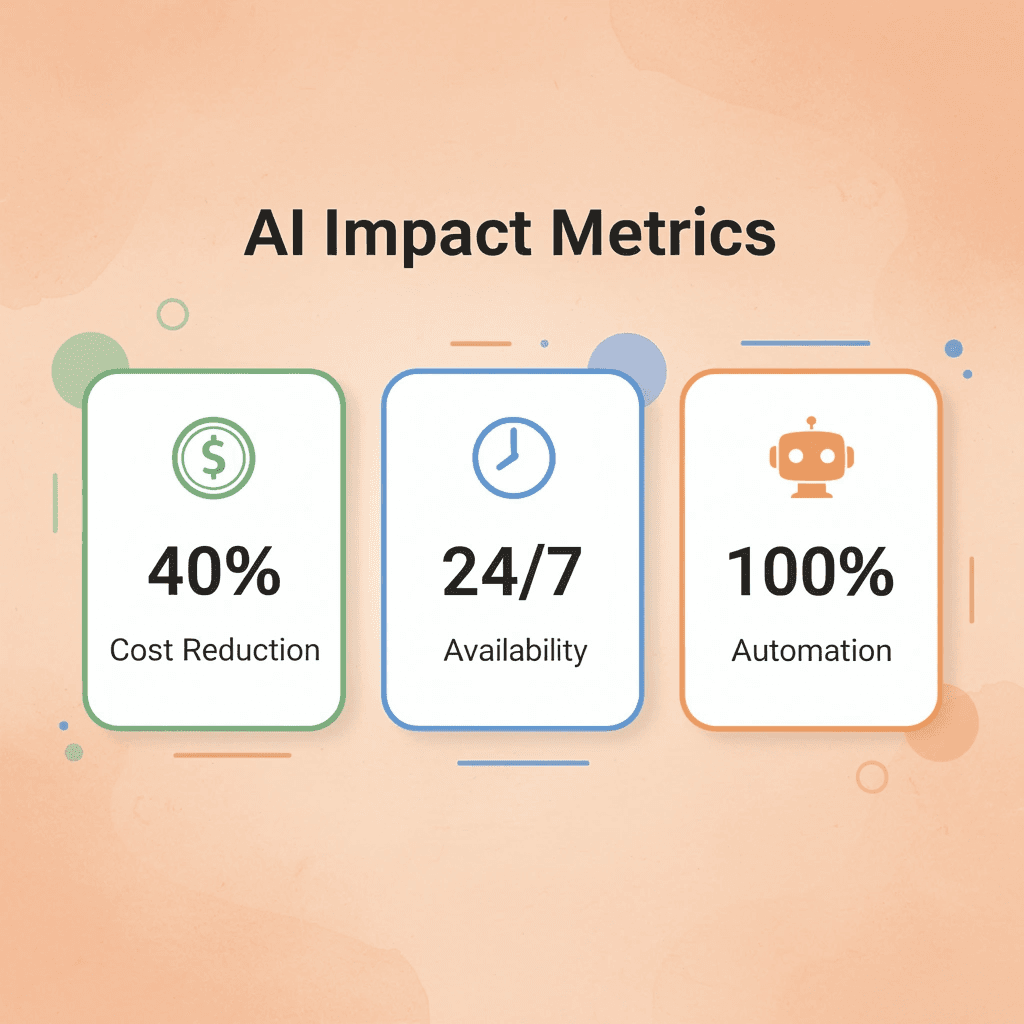
Customer support teams face mounting pressure to deliver instant responses while managing growing ticket volumes and rising customer expectations. Traditional support models struggle to balance speed, quality, and cost-effectiveness, often forcing businesses to choose between fast service and personalized attention. AI transforms this equation by automating routine inquiries, enabling 24/7 availability, and maintaining consistent service quality without expanding headcount.
Modern AI solutions handle multiple conversations simultaneously, freeing human agents to focus on complex issues that require expertise and empathy. This approach delivers both speed and personalization, ensuring customers receive immediate help for common questions and thoughtful assistance for nuanced problems. Businesses ready to transform their support operations can explore advanced conversational AI solutions designed for enterprise-scale customer service.
Summary
- AI can handle 80% of routine customer inquiries without human involvement, according to Pylon's 2025 research. This isn't about replacing support teams. It's about filtering workload so agents stop answering password resets and order-tracking questions 40 times a day and focus on disputes, technical bugs, and emotionally charged situations that actually require judgment. The division changes what support teams do all day, not the number of people you employ.
- Speed creates the emotional experience before customers read your actual reply. AI response times sit under 30 seconds while human teams average 2 to 18 minutes, depending on queue depth. That four-minute difference determines whether customers feel heard or ignored, and it compounds over time. Customers who receive immediate acknowledgment submit fewer duplicate tickets, avoid calling your phone line, and rarely escalate to social media. The behavioral shift reduces total contact volume by intercepting frustration before it multiplies.
- Cost reduction from AI shows up clearly on the P&L. MIT Sloan Management Review reports an average ROI of $3.50 for every $1 invested in AI customer service, while top performers achieve up to 8x returns according to McKinsey. At 50% automation, operational costs drop approximately 35% based on real deployments. The savings come from routing efficiency, not headcount elimination. When AI handles repetitive inquiries, senior agents spend time on billing disputes and technical troubleshooting where their expertise creates actual value.
- Consistency matters especially for regulated industries or companies with complex product catalogs. AI applies the same logic and information to every interaction, pulling answers directly from authoritative sources rather than relying on agent memory. When pricing rules change or new features launch, AI incorporates updates immediately across all channels without retraining lag. There's no risk that some agents know the new policy while others don't, and accuracy improves because retrieval happens from current documentation rather than best recollection.
- Research shows 71% of consumers expect consistency across all online channels, yet only 29% say they receive it. AI's omnichannel capability automatically maintains conversation state across email, social media, live chat, and phone. Customers don't repeat themselves when switching channels. The context from their Twitter DM carries over to the email thread, which connects to the chat conversation they started yesterday. That unified experience happens without requiring custom integration work; most companies don't build it manually.
- The copilot model delivers AI-generated response drafts and context summaries directly to agents before they read tickets, resulting in 3x faster handling with humans making every final call. This accelerates onboarding because new agents become productive faster when supported by AI that knows your entire knowledge base. They don't need six months of experience to handle complex questions, just good judgment and communication skills, while AI provides institutional knowledge. Conversational AI extends this to voice interactions, where agents receive real-time guidance during phone calls rather than searching knowledge bases mid-conversation.
Why Customer Support Is Becoming Impossible to Scale Manually
The problem isn't about skill or effort: customer expectations changed faster than support systems could keep up. What worked with 100 customers breaks at 1,000, and the gap between what customers want and what a human-only team can handle widens every month.

🎯 Key Point: The scaling crisis in customer support isn't a reflection of team capability—it's a structural problem in which traditional support models simply cannot keep pace with the exponential growth in customer volume and expectations.
"Customer service expectations have fundamentally shifted, with 67% of customers now expecting immediate responses across all channels." — Salesforce Customer Expectations Report, 2024
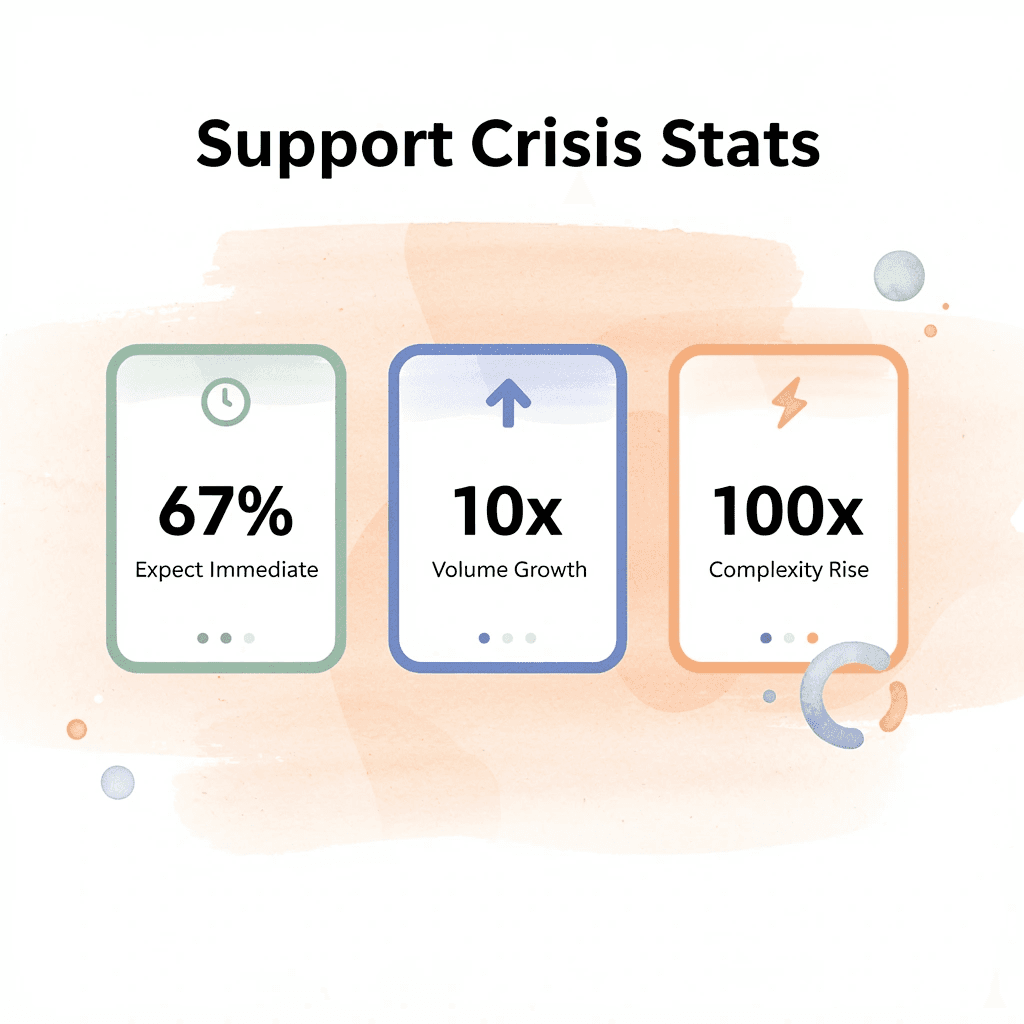
⚠️ Warning: Many businesses underestimate how quickly this gap widens. A 10x increase in customers doesn't just mean 10x more tickets—it means exponentially more complex interactions, higher expectations, and greater pressure on your existing team.
The math stops working
When a digital product creator grows from £180 weekly to £31,000 monthly across eight product lines, support volume doesn't increase proportionally—it explodes exponentially. Every new customer brings questions. Every product launch multiplies inquiry types. Every timezone adds another shift requiring coverage. Meanwhile, the support team remains the same size and works the same hours.
What makes instant response expectations impossible to meet?
According to Zendesk, customer support teams handle an average of 3,400 tickets per month. Yet HubSpot Research found that 90% of customers expect immediate responses. This collision creates an impossible mandate: answer thousands of tickets promptly and consistently, across every channel, without significant hiring.
Quality collapses under pressure
Good support means giving thoughtful, personal responses regardless of ticket volume. Human capacity has limits that customer demand doesn't respect. When volume spikes, response times stretch, agents rush, and quality becomes inconsistent. One bad experience can undo months of goodwill. The traditional approach treats support as a linear cost center: double customers, double staff. But costs scale linearly while customer expectations scale exponentially. Customers expect the same instant, personalized attention they received when you were smaller, plus 24/7 availability.
The hidden cost of doing nothing
Support teams at capacity face a choice: maintain quality and accept longer response times, or maintain speed and sacrifice quality. Either path drives customers away. Customers leave when they wait too long or receive rushed, generic responses. The $62 billion in annual losses from poor customer service demonstrate how small negative interactions accumulate and erode customer loyalty.
How does conversational AI solve the speed versus quality dilemma?
Platforms like conversational AI maintain speed and quality by automating repetitive questions that account for most ticket volume, freeing human agents to handle complex issues that require expertise. Response times drop from hours to seconds. Quality remains consistent whether handling the tenth inquiry or the ten thousandth. The system scales without incurring linear costs. The real question isn't whether manual support can keep up, but what happens to your business while you're still trying to make it work.
Related Reading
- How to Use AI in Customer Service
- How Does AI Improve Customer Service
- How Can Ai Help Customer Service
- AI in Customer Communications For Telecommunications
- How Is Ai Improving Restaurant Customer Service
- AI in Customer Communications in the Insurance Industry
- Ai Agent Challenge In Customer Support
- How Ai Is Changing Customer Service In Telecom
- Ai Appointment Scheduling Healthcare
- Benefits of AI in Customer Support
- Ai Customer Support Implementation Best Practices
- How To Use Ai In Customer Service
How AI Can Actually Handle Customer Support at Scale
How it works
AI works as a filtering layer between incoming requests and your human team. When a customer asks about account access, order status, or password resets, the AI intercepts the request, checks knowledge bases, finds the answer, and responds immediately. The support agent never sees the ticket. According to Pylon, AI can handle 80% of routine customer questions without human intervention. It processes predictable inquiries—tracking numbers, refund policies, and feature explanations—freeing human agents to focus on the 20% requiring judgment, empathy, or creative problem-solving.
The first-line filter
AI acts as triage in support operations by sorting incoming requests by complexity and routing them appropriately. Simple questions receive automated responses drawn from your documentation, while complex issues—billing disputes, technical bugs, and emotionally charged complaints—go to human agents with full context attached. This filtering reduces ticket volume before it reaches your team. Instead of being overwhelmed with hundreds of repetitive questions, agents handle dozens of meaningful cases. Response times improve because the queue stays manageable, and quality increases as agents focus on problems that matter.
Why voice matters differently
Phone calls remain the primary way customers contact support for urgent, serious problems. When someone calls about a failed payment, service outage, or canceled order, they need immediate assistance. Traditional call centers struggle because each representative handles only one customer at a time, leading to longer wait times and customer frustration.
How does conversational AI change the economics of phone support?
Conversational AI reduces phone support costs by handling customer conversations at scale. These systems use natural language processing to understand spoken requests, retrieve answers from knowledge bases, and respond immediately across an unlimited number of simultaneous calls. Teams using voice AI report average wait times dropping to under 40 seconds while providing 24/7 support, which human-only teams cannot match.
The mechanism makes benefits inevitable
Once AI handles repetitive work, human agents can focus on solving problems rather than finding information. Ticket backlogs shrink initially. Training can address complex situations instead of memorizing frequently asked questions. Costs remain steady because the company avoids hiring additional staff with each growth phase.
AI excels at finding patterns and extracting information, while humans excel at making difficult decisions, managing upset customers, and generating creative solutions. This division improves operations and enables easier growth, which is why companies that leverage AI effectively consistently report higher satisfaction scores alongside lower operational costs. Understanding how something works differs from seeing the improvements it makes.
11 Incredible Benefits of AI in Customer Support (What Actually Improves and Why)
The real change is breaking the old connection between customer numbers and staff requirements. When customer numbers double, your costs need not double. This shift transforms how you think about growth, capacity planning, and what your support team does every day.

🎯 Key Point: When AI handles pattern matching, humans focus on judgment calls.
"The shift from linear scaling to intelligent automation fundamentally changes how businesses approach customer support growth and resource allocation." — Customer Support Evolution Report, 2024

💡 Tip: This transformation allows companies to achieve sustainable growth without the traditional linear increase in operational costs, making customer support a strategic advantage rather than just a cost center.
1. Speed That Changes Customer Behavior
How fast you respond to customers matters more than you might think. When customers receive a message within 30 seconds instead of waiting eight minutes, they feel better about your brand immediately, even before reading your response.
What are the actual time differences between AI and human responses?
Across 1,000 daily questions: AI response time sits under 30 seconds, while human response time ranges from 2 to 18 minutes depending on queue length. At 70% automation, blended first-response time drops to 3–4 minutes. At 30% automation, you're averaging 7–8 minutes. That four-minute difference determines whether customers feel heard or ignored.
How does immediate acknowledgment reduce contact volume?
Customers who receive quick acknowledgment are less likely to submit duplicate tickets, call your phone line, or escalate to social media. This behavioral shift reduces total contact volume by preventing frustration from multiplying.
2. 24/7 Support Without Night Shift Economics
Human support teams need shift coverage, overtime pay, and staff across multiple locations to provide 24-hour help. AI works continuously without these requirements. Customers receive assistance at 2 a.m. on Sunday with the same quality as Tuesday afternoon.
Why does global time zone coverage matter for customer support?
This matters especially for global products serving multiple time zones. A customer in Sydney doesn't wait for your San Francisco team to clock in. The interaction happens immediately in their preferred language, without staffing complexity or extra labor costs.
How does AI maintain consistent support quality around the clock?
AI doesn't get tired, experience mood changes, or perform worse during late shifts. The quality of help remains consistent regardless of when customers reach out.
3. Cost Reduction That Actually Shows Up on the P&L
50% automation leads to approximately 35% reduction in operational costs, based on real deployments. Fewer routine tickets reaching human agents reduces staffing needs and cost per resolution. MIT Sloan Management Review reports an average return on investment of $3.50 for every $1 spent on AI customer service. Top-performing organizations achieve up to 8x returns according to McKinsey, while Gartner projects a 30% reduction in contact center labor costs from agentic AI by 2029.
What drives the most significant cost reductions?
Cost savings come from better routing, not eliminating jobs. When AI handles password resets and order status checks, senior agents focus on billing disputes and technical troubleshooting, where their expertise creates value.
4. Improved Efficiency Through Task Redistribution
AI handles repetitive questions at scale, freeing human agents to focus on higher-value work. A support representative who previously spent 60% of their day answering "Where's my order?" and "How do I reset my password?" can now focus on cross-selling, upselling, and solving complex problems. When routine questions are filtered automatically, the remaining ticket queue contains only interactions that require human attention. This shift improves job satisfaction, reduces burnout, and enhances the quality of customer interactions that demand empathy and creativity.
What revenue impact follows from improved efficiency?
Revenue impact follows naturally. Agents with time to understand customer context can identify upgrade opportunities, suggest complementary products, and build relationships that increase lifetime value. These conversations don't happen when drowning in basic inquiries.
5. Personalized Customer Experience at Scale
AI analyzes customer engagement data and company knowledge to provide tailored recommendations and responses. According to research, 81% of service professionals say customers expect a more personal touch. AI enables this personalization without requiring agents to manually review purchase history, previous interactions, and account details before each response.
How does contextual awareness improve customer interactions?
The system recognizes returning customers, references past conversations, and adjusts tone based on customer sentiment. A frustrated customer who has contacted support three times about the same issue receives a different response than a first-time user asking a basic question. This contextual awareness is built in from the first message, eliminating the need for institutional knowledge and long agent tenure.
What role does proactive support play in personalization?
Personalization also includes product recommendations and proactive support. If usage patterns suggest a customer might benefit from a specific feature or face a common problem, AI surfaces that information before the customer asks, creating an attentive rather than reactive experience.
6. Scalability Without Proportional Headcount Growth
Seasonal spikes, product launches, and viral moments can overwhelm a fixed support team overnight. AI scales instantly without hiring timelines, handling thousands of simultaneous conversations without degradation or ramp-up time. This protects customer experience from headcount bottlenecks. When a marketing campaign drives 10x normal traffic or a product issue affects thousands of customers simultaneously, everyone receives immediate acknowledgment and initial triage, rather than waiting in extended queues.
Why is traditional scaling too slow for modern support needs?
Traditional scaling requires forecasting demand weeks in advance, posting job listings, conducting interviews, onboarding, and training new hires. By the time that process completes, the spike has often passed. AI removes that lag entirely.
7. Sentiment Analysis That Adjusts in Real Time
AI can detect customer emotions and adjust its responses accordingly. Frustrated language or an escalating tone triggers different handling than neutral questions, allowing the system to flag high-emotion interactions for immediate human review or adjust its response style to de-escalate tension.
Why does tone matter as much as information?
How you say something matters as much as what you say. A technically correct response that lacks empathy can further upset a frustrated customer. AI trained on sentiment patterns learns when to acknowledge frustration directly, when to apologize, and when to escalate an issue rather than attempt to resolve it.
How does real-time adaptation work during conversations?
Detection happens immediately. If a conversation in a thread becomes heated, the system adjusts its approach rather than remaining static.
8. Seamless Multichannel Service
AI works across email, social media, live chat, and phone to maintain consistency. Customers don't repeat themselves when switching channels: information from their Twitter DM carries over to email threads and chat conversations.
Why do customers expect multichannel consistency?
Research shows that 71% of consumers expect the same experience across all online channels, yet only 29% report receiving it. AI's ability to work across multiple channels closes this gap by providing a complete view of the customer journey, enabling better decisions and smoother service.
How does AI handle complex multichannel integration?
Keeping conversations going across different platforms, matching customer identities, and syncing information requires infrastructure that most companies cannot build manually. AI handles this complexity automatically, delivering the smooth experience customers expect without custom integration.
9. Anticipating Customer Problems in Advance
AI predicts problems before they happen using predictive analytics powered by machine learning. These systems analyze product usage data, customer feedback, and support interactions to identify patterns that signal future challenges. Customer service teams can predict when customers might leave by noticing changes in behavior, declining engagement, or repeated low-satisfaction interactions. Agents can then reach out proactively to address the underlying issue before it's too late. AI provides guidance when usage patterns suggest a customer will encounter a known limitation or common obstacle, helping prevent frustration before it builds and fundamentally changing how the customer experiences the product.
10. Consistency and Accuracy Across Every Interaction
AI delivers responses in your company's approved tone and voice, based on your knowledge and data. This ensures customers receive consistent experiences and reduces errors. Unlike human agents who may interpret policies differently or miss updates, AI applies the same logic and information to every interaction.
Why is consistency critical for regulated industries and complex businesses?
Being consistent is critical for regulated industries and companies with complex product catalogs. When pricing rules change, return policies update, or new features launch, AI incorporates those changes immediately across all channels without retraining lag or the risk that some agents know the new policy while others don't. Accuracy improves because AI retrieves information directly from authoritative sources rather than relying on memory. Answers come from current documentation, not an agent's recollection.
11. Agent Augmentation The Copilot Model
The copilot model provides agents with AI-generated draft responses and context summaries before they read the ticket, enabling 3 times faster ticket handling while keeping humans in control of all final decisions.
How does the Copilot model work for shared support teams?
This matters especially for shared support teams managing multiple products. AI handles knowledge retrieval, bringing up relevant documentation, previous similar tickets, and suggested responses. Humans make judgments: assessing whether a response fits the situation, adjusting tone based on the customer's emotion, and making decisions that require empathy or creativity.
Platforms like conversational AI extend this to voice interactions, where our system listens, retrieves information, and surfaces it in real-time while agents maintain natural conversation flow. Agents receive guidance during calls rather than pausing to search knowledge bases, allowing them to focus on connecting with customers.
What impact does AI Copilot have on agent onboarding?
The copilot approach accelerates onboarding. New agents become productive faster because AI provides institutional knowledge, while they contribute good judgment and communication skills. But none of these benefits matter if implementation breaks the customer experience you've spent years building.
Related Reading
- It Helpdesk Automation
- Best Voice Ai For Restaurants
- How To Improve Call Center Customer Service
- How To Use Ai For Customer Service Call Center
- Best Ai Customer Service For Hotels
- Best Ai Tools For Customer Support In Healthcare
- Ai Customer Support Automation In Telecom
- How To Use Ai To Improve Customer Service Kpis
- Best Ai Customer Support Tools For It Teams
- Patient Support Services Automation
How to Use AI in Customer Support Without Hurting Customer Experience
AI in customer support works well when it handles simple, repeated questions and escalates harder problems to people. Success requires training with real support data, monitoring performance, and making adjustments based on failures. Poor AI support frustrates customers and creates additional work for teams.
🎯 Key Point: The secret to successful AI implementation is knowing exactly what tasks to automate and what to keep human-handled. Poor boundaries between AI and human support create more problems than they solve.

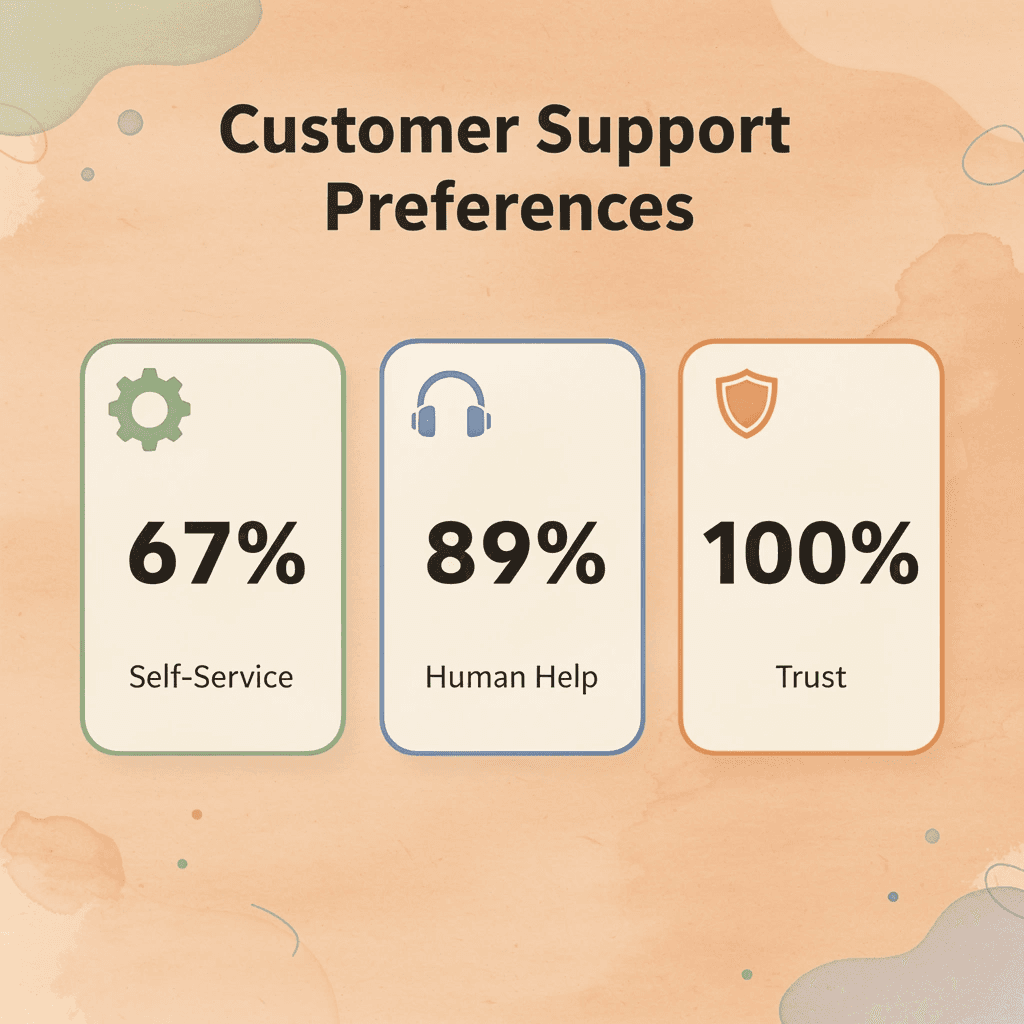
"67% of customers prefer to solve simple issues through self-service options, but 89% want human agents for complex problems." — Zendesk Customer Experience Trends, 2024
How responsibilities are split between AI and humans
- AI should handle
- Password resets
- Order status checks
- FAQ responses
- Basic account information
- Humans should handle
- Billing disputes
- Product complaints
- Technical troubleshooting
- Escalated issues
⚠️ Warning: Never deploy AI support without extensive testing on real customer queries. An untrained AI that gives wrong answers can damage customer trust in ways that take months to repair.
Step 1: Deploy AI for first-line support filtering
Start by identifying questions that follow predictable patterns, such as password resets, order tracking, account access, refund policy questions, and basic troubleshooting. AI chatbots resolve up to 80% of routine questions instantly, freeing your agents to focus on problems requiring human expertise. According to IBM, 90% of customers expect immediate responses, though most involve straightforward information retrieval rather than complex problem-solving. AI satisfies that demand without exhausting your team. The goal is to filter intelligently so humans focus on what matters.
Step 2: Route complex issues to humans with full context
AI breaks when handling disputes, billing complications, technical bugs, or emotionally charged situations. These require judgment, not pattern matching. The system should recognize its limitations and escalate immediately, passing the full conversation history so the customer doesn't repeat themselves. That handoff determines whether AI feels helpful or obstructive.
What happens when AI attempts to resolve complex issues without human oversight?
Many teams fail when AI attempts to solve problems requiring human judgment or careful analysis of evidence. A customer uploads a video showing a delivery problem, but the AI system automatically deducts payment without human review. The business loses trust, the customer remains frustrated, and the support team inherits a preventable problem. Escalation isn't an AI failure; it's a design feature that should be built in from the start.
Step 3: Train AI on real support data, not assumptions
AI accuracy depends entirely on what it learns from. Feed it actual support tickets, real customer language, and genuine resolution patterns from your team. Generic training produces generic responses that miss your specific context. Track intent match rates and confidence scores to identify where the system guesses instead of knows. High fallback rates and frequent "I don't understand" responses signal incomplete training data.
How do you improve AI responses over time?
Research from NICE shows that 73% of customers expect companies to understand their unique needs. If your assistant cannot distinguish between a first-time buyer asking about shipping and a repeat customer disputing a charge, it lacks proper training. Use A/B testing and reinforcement learning from human feedback to improve responses over time. AI improves only through active instruction.
Step 4: Monitor resolution rate, escalation rate, and customer satisfaction
Track how many issues AI resolves without human intervention, how often it escalates to humans, and customer satisfaction scores. Rising escalation rates reveal gaps in training or tasks unsuitable for automation. Declining satisfaction scores indicate where automation degrades the experience. These metrics reveal whether AI improves team performance or creates new problems.
How can poor training damage customer relationships?
Bad training leads to wrong answers, which erode trust and drive customers away. Monitor sentiment analysis to catch frustration early. If negative language increases during AI interactions, adjust tone, response quality, or escalation thresholds. Continuous iteration separates helpful AI from harmful AI.
What makes AI customer service truly effective?
AI's benefit isn't automation—it's amplification. It works when it frees your team to focus on complexity, empathy, and judgment while handling repetitive work. But that only happens if you design the system with clear boundaries, train it with real data, and monitor what improves. Otherwise, you've added friction between customers and the help they need.
Related Reading
- Lindy Ai Vs Zapier
- Best Ai For Insurance Agents
- Lindy Ai Alternative
- Best Ai Voice Agents For Insurance
- How Is Ai Helping In The Healthcare Industry
- Botpress Alternative
- Best Ai Tools For Insurance Customer Service
- Relevance Ai Alternative
If Customer Support Can't Scale Manually, the Next Step Is Designing a System That Can
The shift isn't about adding more people or tools. It's about redesigning the first layer of customer interaction so simple requests resolve instantly, and human teams handle only what requires judgment. That means building a system where AI handles repetitive demand before it reaches your agents, not after they're overwhelmed.

💡 Key Point: The most effective scaling happens when AI intercepts routine inquiries before they consume human resources, not after your team is already stretched thin.
Bland AI helps companies make that shift by replacing traditional call center workflows and IVR systems with real-time AI voice agents that automatically handle customer conversations. Instead of missed calls, long queues, or inconsistent experiences, businesses route high-volume interactions through our system that responds instantly and scales without bottlenecks. The result is measurable: reduced wait times, 24/7 coverage, and operational costs that don't climb with demand.
"AI-powered customer service systems can reduce operational costs by up to 40% while maintaining 24/7 availability that traditional teams can't match." — Enterprise AI Report, 2024
🎯 Takeaway: Book a demo to see how this works for your setup. Share your current call flow and get a breakdown of what your AI layer would handle, what stays with your team, and where you can immediately reduce load without losing control or compliance.